A Complete Guide to Common Math Symbols and Their Meanings
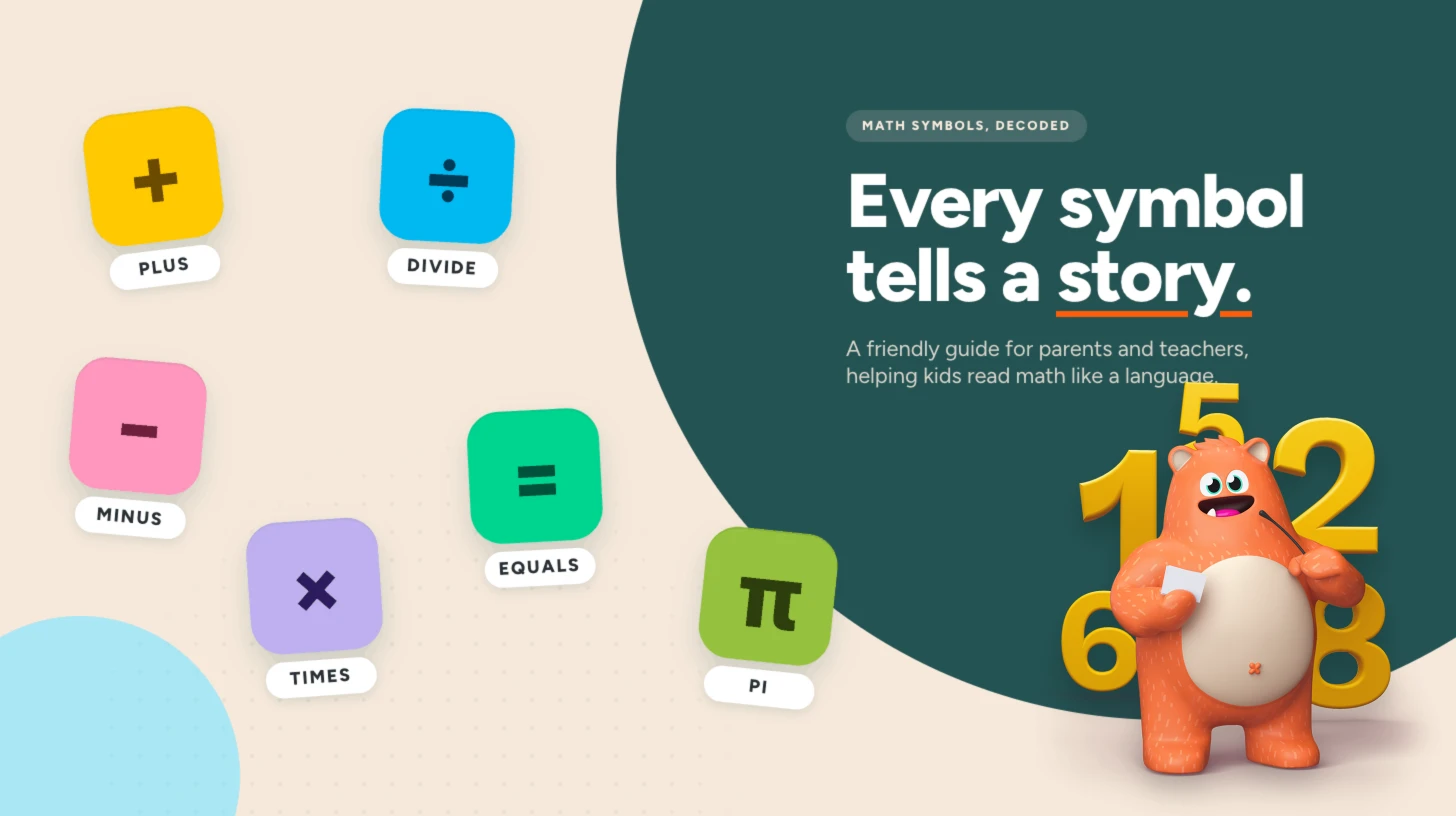
Math has its own language. And just like how you learned to read in English, knowing what mathematical symbols mean is the first step to reading math problems. Once you've got it down, you'll understand what equations and solutions you're looking for.
Don't forget to bookmark this page and keep our math symbols list as a handy guide!
Note for Parents and Teachers: This guide focuses on the most common math symbols used in Grades 1 to 8-level math. It does not include information about more advanced levels of math. On this page, you'll find plenty of resources, including activities and math symbols charts, to help your kids understand math symbols and how they're used in different math topics.
Why Math Symbols Are Important for Kids
As early as preschool, children start grasping the idea of numbers. They can count how many apples are in a basket or how many flowers there are in the garden. However, their concept of math needs to grow and understand that:
- Numbers are values that can be manipulated.
- Numbers can be compared with other numbers.
- Some values are used so often that they have their own special symbols.
Math symbols and signs help express mathematical thoughts. They tell students, "This is what we're looking for," or "This is what we need you to do to find the answer." When you can understand math symbols, you can understand math problems.
How Symbols Simplify Complex Ideas
Younger children often start learning math operations without symbols. For example: If you have one piece of candy and your mom gives you two more pieces, how many do you have?
This is easier to understand because it's a real-life example. However, math is a theoretical subject, which means candy isn't always the best example for understanding more complex problems.
In this case, the equation will be: 1 + 2 = ?
Gradually, word problems will evolve to include more complex operations. For example: ( 1 + 2 ) × ( 5 - 3 ) =
Mathematical symbols also simplify problems. Instead of writing "Find the quotient of 25 and 5," a teacher can simply write 25 ÷ 5 = ?
Building a Strong Foundation for Future Math Learning
Math will become more advanced in high school and college, with some problems involving more symbols than actual numbers. Expect kids to use variables and symbols like θ and Σ down the line.
Understanding the basics gives kids a strong foundation. When they've got a good grasp of the most common math symbols, they gain the skills needed to tackle more complex mathematical concepts.
Common Struggles Kids Face With Symbols
As students learn more math symbols, there are common mistakes and misconceptions that can affect their learning journey. Addressing these early prevents confusion before moving on.
Confusing × and x
The multiplication symbol looks a lot like the variable "x." You can replace × with "*" or "⋅", or use a different letter variable instead of "x" to avoid confusion.
Mixing Up > and <
A helpful trick: imagine those symbols as crocodiles that want to eat the bigger value. The crocodile's mouth always faces the larger number.
Confusing + and ×
Help your child use their pointer fingers to mimic the symbol. One finger pointing up = addition (+). Both fingers pointing in the same direction = multiplication (×).
Understanding =
Some students think "=" means "is" instead of "equals." This causes confusion with problems like:
- 7 = 3 + 4 — they might think starting with 7 always gives 3 and 4.
- 6x + 8 = 50 — without direction to find x, students may not know where to begin.
Misreading ÷ and the Fraction Bar
Some problems use "/" instead of ÷ to show division. Be consistent — use a horizontal line for fractions in the classroom. Use parentheses "()" when using "/" for division to clarify grouping.
In Google Docs, go to Insert > Symbols > Equations, click "New equation," then select the fraction symbol.
Forgetting Units in Measurement Problems
Always require kids to include the correct unit in their final answer. "16" could mean seconds, minutes, or hours — the unit provides context and confirms correct reasoning.
Categories of Common Math Symbols
These are the math symbols students from Grades 1 through 8 will most frequently encounter in their lessons.
Numbers and Basic Operations Symbols
These symbols transform numbers — used in everyday situations from counting money to sharing with friends.
+ Plus / Addition
Combine the values on either side of this symbol.
- A team scored 10 points in the first half and 12 in the second. Total? (10 + 12 = ?)
- You read 18 pages yesterday and 22 today. Total? (18 + 22 = ?)
− Minus / Subtraction
Subtract the value on the right from the value on the left.
- You have 17 stickers and gave 8 away. How many left? (17 − 8 = ?)
- A meal costs $4.89; you pay with $20. Change? ($20 − $4.89 = ?)
× Times / Multiply
Add the first value to itself as many times as the second value states.
- Movie ticket: $15 per person × 5 people = ? ($15 × 5 = ?)
- Each basketball hoop = 5 points. Made 9 shots. Score? (9 × 5 = ?)
÷ Divide
Split a number into equal groups.
- 8 pizza slices among 4 people. Slices each? (8 ÷ 4 = ?)
- $160 monthly allowance over 20 school days. Daily amount? ($160 ÷ 20 = ?)
Comparison Symbols
Used to compare values between numbers and equations.
= Equal
Both sides have the same value.
- Brother gives 5 blue + 6 red marbles; sister gives 4 blue + 7 red. Same total. (5 + 6 = 4 + 7)
- Buy 2 dolls, get 2 free = 4 dolls total. (2 + 2 = 4)
≠ Not Equal
The left value does not equal the right value.
- Small apple: 100 g. Big apple: 180 g. (100 g ≠ 180 g)
- You need 20 carnival tickets; you earned only 19. (20 ≠ 5 + 12 + 2)
< Less Than
The left value is smaller than the right value.
- You are 13; your grandmother is 75. (13 years < 75 years)
- You collected 15 seashells; your cousin collected 17. (8 + 7 < 5 + 12)
> Greater Than
The left value is bigger than the right value.
- You can invite 5 friends; only 4 are invited so far. (5 > 1 + 1 + 1 + 1)
- Bus capacity: 50; current passengers: 43. (50 > 43)
≤ Less Than or Equal To
The left value is smaller than or equal to the right value.
- Toy is "Best for ages 3 and under"; your sister is 2. (2 years ≤ 3 years)
- Ferris wheel cabin fits up to 6; your group has exactly 6. (6 ≤ 6)
≥ Greater Than or Equal To
The left value is bigger than or equal to the right value.
- Must be at least 18 to buy a car; your uncle is 45. (45 years ≥ 18 years)
- Team needs at least 20 points to win; they scored 24. (24 ≥ 20)
Fractions, Decimals, and Percentages
Not all numbers can be counted as a whole. Mastering rational numbers is important before students move on to irrational numbers.
X/Y Fractions
A fraction represents part of a whole — written with a numerator (top: parts you have) and denominator (bottom: total parts in a whole).
Example — ⅔: A cake has 3 slices. You eat 2, so you ate ⅔ of the cake, leaving ⅓. Eat the last slice and you've had the whole cake (3/3).
. Decimal Points
Decimal points show parts of a whole. Numbers to the right of the decimal are less than one whole.
- A candy bar at a vending machine costs $0.50 — less than $1.
- A pencil between 7 and 8 inches measures 7.5 inches.
% Percent
A percentage represents a fraction out of 100. Multiply a decimal by 100 to convert: 0.01 = 1%, 0.50 = 50%, 1.00 = 100%.
- A 50% sale on an $80 game reduces it to $40.
- Scoring 90% on a 20-question quiz = 18 correct answers (0.9 × 20 = 18).
Geometry Symbols
By Grade 4, students will be introduced to geometry and these key symbols.
° Degree
Degrees measure angles (and temperatures). A full rotation equals 360°.
- Clock hands forming a straight line = 180° (half of 360°).
- A pizza cut into 4 equal slices creates 90° angles at each cut (360° ÷ 4).
∥ Parallel Lines
Two lines that never meet, no matter how far they extend.
- Ladder beams: always the same distance apart, never intersecting. Line A ∥ Line B.
- On a rectangular desk with corners A, B, C, D: AB ∥ DC.
⊥ Perpendicular Lines
Two straight lines that form a 90° right angle where they intersect.
- A railroad crossing sign with lines RD and CG: RD ⊥ CG.
- The edges of a school book meet at right angles: A ⊥ B.
△ Triangle
Represents a triangle — 3 sides, 3 corners, 3 angles. Written before the triangle's name.
Example: A pizza slice with corners A, B, and C = △ABC.
☐ Square
Represents a square — 4 equal sides and 4 right angles. All squares are quadrilaterals, but not all quadrilaterals are squares.
Example: A window with 4 equal glass panels: ☐A, ☐B, ☐C, ☐D, and the full window = ☐E.
∠ Angle
Represents an angle formed by two intersecting lines. Three letters follow: first point, vertex (always middle), second point.
Example: A clock with hour (H), minute (M), and second (S) hands meeting at center point (A) creates angles: ∠SAH, ∠MAH, ∠SAM.
π Pi
Pi is the ratio of a circle's circumference to its diameter — an irrational number that never ends. We use π instead of writing its full value.
Example: An NBA basketball with diameter ~9.4 inches: C = π × 9.4 ≈ 29.5 inches.
Measurement and Units
Units give numbers real-world meaning. Always include the correct unit — it makes the difference between a cute puppy and a record-breaking giant.
Weight
Imperial: ounces (oz), pounds (lbs), tons (t) | Metric: milligrams (mg), grams (g), kilograms (kg)
- Children's backpacks should weigh no more than 15 lbs.
- A cake recipe calls for 2 cups of flour ≈ 240 g.
Length and Distance
Imperial: inches (in), feet (ft), miles (mi) | Metric: millimeters (mm), centimeters (cm), meters (m), kilometers (km)
- The distance from California to Florida is about 2,700 mi.
- The swimming pool is about 2 m deep.
Liquid Volume
Imperial: fluid ounces (fl oz), pints (pt), gallons (gal) | Metric: milliliters (mL), liters (L), kiloliters (kL)
- A can of soda has 12 fl oz.
- The doctor prescribed 5 mL of medicine daily for a week.
Temperature
Measured with the degree sign (°): Fahrenheit (°F) in the U.S., Celsius (°C) in most countries, Kelvin (K) in advanced physics.
- John had a mild fever of 100.9 °F.
- Alaskan winters can reach −30°C.
Money
Use the correct currency symbol: U.S. dollar ($), Euro (€), Yen (¥), British Pound (£).
- The shoes were on sale for $74.99.
- Mom gave my sister $30 to buy new clothes.
Algebra Symbols
If math is a language, algebra is its trickier vocabulary. Understanding these symbols helps students process equations more effectively.
Variables (x, y, z, a, b, c, n…)
Letters used to represent unknown values. Any letter can be a variable.
- Julia's piggy bank + $10 from parents = $23 total. (x + $10 = $23)
- 36 cookies shared equally; each person gets 4. How many people? (36 ÷ a = 4)
± Plus or Minus
Indicates two possible answers — higher or lower. Often used for ranges or margins of error.
- Thermostat showing 20°C ± 2 means the temperature is between 18°C and 22°C.
- You estimate your game score as 50 ± 5 (between 45 and 55 points).
∞ Infinity
Represents an endless amount — there is always a number larger than the largest you can think of.
Example: Outer space is believed to still be growing — its size is symbolically described as ∞.
( ) Parentheses
Group numbers or operations. Per the order of operations, parentheses are solved first.
- Mom buys 3 apples at $2 and 2 lemons at $1: (3 × $2) + (2 × $1) = ?
- Kyle and Sarah each eat 2 cookies and 1 brownie: (2 + 1) × 2 = ?
[ ] Brackets
Like parentheses, but for more complex equations with multiple groupings.
Example: Start with $50, spend on lunches, candy, and a movie, then parents double your leftovers: [$50 − ($4.50 × 5) − ($1.75 × 2) − $18] × 2 = ?
Fun Ways To Help Kids Learn Math Symbols
Studies show kids learn better when they're having fun. Happy memories stick, and a low-pressure environment builds real confidence.
Flashcards and Symbol-Matching Games
Turn symbol identification into a game. In a classroom, add friendly competition. Use fill-in-the-blank equations like:
- 5 _ 5 = 10
- 6 + 8 _ 14
- π = 3_14
- 6 _ 7
Real-Life Examples
Kids connect with math more easily when it appears in familiar situations — baking, shopping, or keeping score in a game. Relatable problems make symbols meaningful.
Interactive Worksheets and Puzzles
Make learning feel like unlocking answers rather than a chore. Interactive worksheets let kids progress at their own pace, and online tools help teachers and parents track progress and identify areas needing extra support.
Beyond the Basics: Symbols Kids Will See Later
There are far more math symbols than those covered here. Grade 1–8 students won't need all of them yet — but here's a preview of what's ahead in high school and beyond:
- θ (Theta) — Most commonly used in trigonometry.
- Σ (Sigma) — Means "the sum of," used in more advanced algebra.
- ∧ (And) — Used when two conditions must both be true.
- ∨ (Or) — Used when at least one of two conditions is true.
- ∩ (Intersection) — Shows overlapping elements between two sets.
- ∪ (Union) — Combines all elements from two sets.
Final Thoughts
Math symbols are used in many different ways. Your kids will encounter them throughout their math lessons, which is why it's so important they understand what each one means. A solid grasp of basic mathematical symbols gives students the foundation they need to tackle more advanced concepts at every stage.
At Prodigy, we strive to help teachers and parents make math more accessible for students from Grades 1 to 8. We provide fun games and plenty of resources to help make math engaging for kids. Browse our worksheets, quizzes, and other online resources to see how laughter and joy can transform the learning experience.